
Designing High-End Cardigans: Cropped Zip vs. Cable-Knit Crewneck Styles for Seasonal Collections
Let me start with something I've been noticing over the past few seasons. The cardigan – that humble, sometimes frumpy wardrobe staple – is having a moment. And I don't mean a fleeting trend. I mean a genuine, structural shift in how luxury consumers think about knitwear.
1. Introduction: The Cardigan's Comeback
Let me start with something I've been noticing over the past few seasons. The cardigan – that humble, sometimes frumpy wardrobe staple – is having a moment. And I don't mean a fleeting trend. I mean a genuine, structural shift in how luxury consumers think about knitwear.
According to EDITED, full-price sellouts across sweaters and cardigans are up year-on-year for key luxury players: in 2026, knitwear sellouts increased 40% at Loro Piana and 23% at Brunello Cucinelli, while the knitwear category saw strong gains across houses including Dior and Gucci. Demand for premium yarns like cashmere has surged, now accounting for a third of knitwear sellouts across luxury retailers. The global cashmere knits market was valued at US$5,233 million in 2025 and is projected to reach US$7,266 million by 2032.
Here's the thing: consumers aren't just buying any cardigan. They're buying designed cardigans. Pieces that tell a story. Pieces that fit a specific silhouette. And right now, two styles are dominating the conversation in luxury knitwear: the cropped zip cardigan and the cable-knit crewneck cardigan.
I've been working in luxury knitwear product development for about twelve years now, and I've seen a lot of styles come and go. But these two? They represent something deeper. One is about modernity, precision, and a sharp, intentional silhouette. The other is about heritage, texture, and the kind of craftsmanship that you can literally feel when you run your hand across the fabric.
When you're designing high-end cardigans for seasonal collections, the choice between these two styles isn't just aesthetic – it's strategic. It affects your yarn selection, your production timeline, your pricing architecture, and ultimately, how your customer experiences the garment.
What I want to do in this post is walk you through the practical design considerations for each style. Not a superficial trend report – you can find those anywhere – but a genuine discussion of what goes into creating these pieces at a luxury level. I'll share some numbers, a real case study, and the kind of decision framework I wish someone had given me years ago.
2. The Cropped Zip Cardigan: Modern, Sharp, Uncompromising
The cropped zip cardigan is the style that says "I know exactly what I'm doing." It's confident. It's intentional. And it's surprisingly difficult to get right.
The Silhouette
The defining feature of a cropped zip cardigan is, obviously, the length. But here's what a lot of people miss: where it hits matters enormously. A true cropped cardigan hits at or just above the natural waist – not at the hip, not at the ribcage. The sweet spot is typically around 18-22 inches in length, depending on the size.
Why does this matter? Because the cropped proportion creates a deliberate break at the waist. It's designed to be worn with high-waisted trousers or skirts, which have been dominant in the market for several seasons now. The relationship between the cardigan's hem and the waistband of the bottom is the entire point.
Most cropped zip cardigans feature a relatively fitted silhouette through the body – not skin-tight, but definitely not oversized. The fit should skim the body without clinging. Dropped shoulders are common because they add a relaxed counterpoint to the otherwise precise proportions.
The Closure
The zip is where this style gets its name and its attitude. Unlike a button-front cardigan, which feels traditional and somewhat formal, a zip closure feels modern and utilitarian. It's the kind of detail that signals "this is not your grandmother's cardigan."
Two-way zippers are increasingly common in luxury cropped cardigans. They allow the wearer to adjust the opening from the bottom as well as the top, creating different silhouettes and styling options. Some designers are taking this further – Rick Owens, for example, has experimented with zip fastenings that run along the neckline of his cropped cardigans.
The hardware matters enormously at the luxury level. Gold-toned zippers, custom pulls, and even beaded or embellished zipper pulls – like Brunello Cucinelli's signature Monili beads – elevate the piece from basic to distinctive.
The Yarn and Construction
Here's where things get interesting from a production standpoint. Cropped zip cardigans typically work best with finer-gauge knits – think 12 to 16 gauge. The reason is structural: a finer gauge allows for cleaner lines, sharper edges, and better drape. You're not hiding behind chunky texture; the silhouette has to do the work.
Common yarn choices include:
Merino wool – particularly extra-fine merino (around 16-18 microns) for softness without bulk
Cashmere – for that unmistakable luxury hand-feel, though you'll want to consider the weight carefully
Alpaca blends – Rick Owens' cropped zip cardigan uses 48% alpaca, 30% nylon, 20% wool, and 2% elastane – the elastane adds stretch and helps the garment hold its shape
Merino-cashmere blends – a 90/10 or 70/30 blend offers the softness of cashmere with the structure of merino
Ribbed trims at the cuffs and hem are standard – they provide structure and help the garment stay in place. Some designs feature a stand-up collar or turtleneck for a sharper neckline.
Who Is This For?
The cropped zip cardigan appeals to a customer who values modernity and precision. She's typically urban, style-conscious, and looking for pieces that feel current without being trend-driven. She's the woman who wears her cardigan buttoned up as a top, not just as an open layer.
From a seasonal collection perspective, the cropped zip cardigan works beautifully for transitional seasons – spring and autumn – where layering is essential but heavy outerwear isn't yet required. It's also increasingly popular in Spring/Summer collections, where lighter yarns and openwork knits make it feasible to wear knitwear even in warmer months.
3. The Cable-Knit Crewneck Cardigan: Heritage, Texture, Timelessness
If the cropped zip cardigan is about the future, the cable-knit crewneck cardigan is about the past – and I mean that as the highest compliment.
The Heritage
Cable knitting has deep roots. The patterns originated in the Aran Islands off the west coast of Ireland, where fishermen's sweaters were knitted with intricate cable, diamond, honeycomb, and basket stitches. Each stitch carried symbolic significance: cables represented a wish for safety at sea, diamonds symbolized wealth and success, and the zigzag stitch was inspired by the winding cliff paths.
That heritage is what makes a cable-knit crewneck cardigan feel so authentic. When you're designing this style, you're not just creating a garment – you're participating in a tradition that spans generations.
The Texture
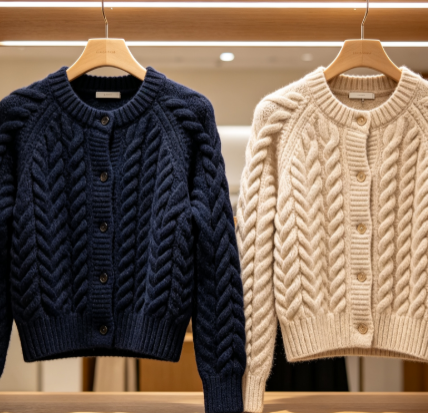
The defining feature of a cable-knit cardigan is, obviously, the cable stitch itself. But there's more to it than just "putting cables on it." The quality of a cable-knit garment depends on:
Stitch definition. This is the single most important factor. A well-knitted cable should have clear, raised twists that you can feel with your fingers. The stitch definition comes from the combination of yarn choice, gauge, and tension. Too loose and the cables look sloppy. Too tight and they lose their dimensionality.
Pattern complexity. Traditional Aran knitting features combinations of cables, diamonds, honeycomb, and basketweave stitches. Modern cable-knit cardigans might use a single, simplified cable pattern or mix multiple textures. The choice affects both the visual impact and the production complexity.
Scale. Cable patterns can be large and chunky or fine and delicate. A chunky cable knit has a more rustic, cosy feel. A finer cable knit – often achieved with merino or cashmere in a tighter gauge – feels more refined and wearable in a broader range of contexts.
The Crewneck
The crewneck is the "classic" neckline for a reason. It's clean, versatile, and frames the face without competing with other elements. At the luxury level, the crewneck on a cable-knit cardigan should have a ribbed trim that sits flat against the body – not too tight, not too loose.
Some designers are experimenting with variations. Polo Ralph Lauren's cable-knit crewneck cardigans feature ribbed trim framing the crew neckline and cuffs. Guest in Residence offers cable-knit cashmere crewneck cardigans that balance heritage knitwear with modern fidelity.
The Closure
Unlike the cropped zip cardigan, the cable-knit crewneck cardigan traditionally uses buttons. The button closure is part of the heritage aesthetic – it feels authentic and slightly formal.
But here's where modern design thinking comes in. I've seen cable-knit cardigans with zipper closures, particularly in more contemporary interpretations. FRAME, for example, offers a cropped cable-knit merino wool zip-up cardigan that riffs on classic bomber jackets. The cable stitching maintains the classic style while the zip and cropped length update it.
The Yarn and Construction
Cable knits generally require heavier yarns and looser gauges than fine-gauge knits. The cables need substance to stand out – they need yarn that has enough body to hold the twist.
Common yarn choices include:
Merino wool – extra-fine merino is popular for its softness and warmth. Aritzia's Heritage Knit uses 100% extra-fine merino wool for its cable-knit crewneck cardigans
Cashmere – for a more luxurious, softer cable knit. Guest in Residence uses cashmere for its plaid cable-knit crewneck cardigans
Merino-cashmere blends – offering the best of both worlds
Donegal tweed wool – for a heritage feel with flecks of colour
The construction of cable-knit garments is typically more labour-intensive than plain knits. The cable patterns require more attention during knitting, and the garments are often worked flat and seamed rather than knitted seamlessly. This adds to both the production time and the cost.
Who Is This For?
The cable-knit crewneck cardigan appeals to a customer who values tradition, craftsmanship, and timeless style. She's looking for a piece that will last for years – maybe decades – and that she can wear in multiple contexts.
From a seasonal collection perspective, the cable-knit crewneck cardigan is quintessentially autumn/winter. The weight and texture make it too warm for summer, but it's perfect for the cooler months. That said, lighter weight cable knits in merino or cashmere can work for transitional seasons as well.
4. Head-to-Head: How the Two Styles Compare
Let me give you a practical comparison. This isn't about which is "better" – it's about understanding the trade-offs.
Design Element | Cropped Zip Cardigan | Cable-Knit Crewneck Cardigan |
Silhouette | Cropped (18-22"), fitted through body | Classic length, often relaxed or slightly oversized |
Closure | Zipper (often two-way) | Buttons (traditional) or zip (modern) |
Neckline | Often stand-up collar or crewneck | Crewneck with ribbed trim |
Stitch Pattern | Plain, ribbed, or textured – gauge is the focus | Cable, diamond, honeycomb – texture is the focus |
Typical Yarn | Fine-gauge merino, cashmere, alpaca blends | Heavier merino, cashmere, Donegal tweed |
Gauge | 12-16 gauge (finer) | 7-9 gauge (heavier) |
Production Complexity | Moderate – focused on precise shaping and fit | Higher – cable patterns require more skill and time |
Seasonal Fit | Transitional (Spring/Autumn) and Summer | Autumn/Winter primarily |
Price Point | Mid-to-high luxury | High luxury |
Customer Profile | Modern, urban, style-forward | Traditional, quality-focused, timeless |
Sources: Industry data and brand analysis
Here's what this tells you in plain English:
The cropped zip cardigan is about precision. It's a more technically demanding garment in terms of fit and silhouette, but the knitting itself is relatively straightforward. The value comes from the design – the proportion, the hardware, the overall concept.
The cable-knit crewneck cardigan is about craft. The knitting itself is more complex and time-consuming, but the silhouette is more forgiving. The value comes from the texture, the heritage, and the tangible sense of quality.
The real insight is that these styles appeal to different customers and serve different roles in a collection. A well-designed seasonal collection might include both – the cropped zip for the modern, trend-aware customer, and the cable-knit crewneck for the heritage-conscious, investment-minded customer.
5. Case Study: Alanui's 10-Year Knitwear Journey
Let me share a concrete example that illustrates these principles in action.
Alanui, the luxury knitwear brand founded by Carlotta and Nicolò Oddi, recently celebrated its 10-year milestone with a Fall 2026 collection that perfectly demonstrates the interplay between these two cardigan styles.
The brand's signature piece is a jacquard belted cardigan – a style that combines the structure of a cardigan with the impact of a statement piece. But for Fall 2026, Oddi expanded the offering significantly.
She introduced college-inspired cardigans and crewneck sweaters featuring seasonal symbols as patches. These pieces represented a more heritage-oriented direction for the brand, with the crewneck silhouette and patch details evoking a preppy, traditional aesthetic.
At the same time, the collection featured newer silhouettes like cropped or boxy jackets – a clear nod to the modern, cropped proportion that's dominating the market.
What I find fascinating about this collection is how it demonstrates that these two styles aren't mutually exclusive. Alanui's customer might buy the heritage-inspired crewneck for its timeless quality, and the cropped silhouette for its contemporary edge. They serve different needs within the same wardrobe.
The collection also showcased the importance of yarn selection in defining each style. Alanui used cashmere, virgin wool, and fine merino wool for the cozier pieces, and lighter wool-silk blends for the more modern silhouettes. This is exactly the kind of strategic material selection that separates a thoughtful collection from a random assortment.
The brand's journey is also worth noting from a business perspective. After regaining full control of the company and rethinking its operations, the cofounders established new headquarters in Milan, consolidating all activities under one roof. This kind of operational maturity is what allows a knitwear brand to scale while maintaining quality – a lesson that's relevant whether you're designing cropped zip cardigans or cable-knit crewnecks.
6. Practical Decision Framework for Your Seasonal Collection
Okay, so how do you actually decide which style to develop – and how many of each? Here's the framework I use.
Step 1: Define your seasonal narrative.
What story is your collection telling? If it's about modernity, urban energy, and a forward-looking perspective, the cropped zip cardigan is your answer. If it's about heritage, craftsmanship, and timeless quality, the cable-knit crewneck is the way to go. And if your collection has room for both narratives – as Alanui's did – you can develop both.
Step 2: Know your customer.
Who is actually buying your brand? If your customer base skews younger and more trend-aware, the cropped zip cardigan will resonate. If they skew older and more investment-minded, the cable-knit crewneck is a safer bet. But here's the thing – many luxury customers are both. They want modern pieces and heritage pieces. They're not a monolith.
Step 3: Consider your production capabilities.
Can your manufacturer execute complex cable patterns? Do they have the machinery for fine-gauge knits? What about the finishing – zipper installation versus button attachment? These are practical questions that will affect both quality and cost.
Step 4: Calculate the cost.
A cable-knit crewneck cardigan in cashmere will cost significantly more to produce than a fine-gauge merino cropped zip cardigan. But the retail price point can also be higher. You need to understand your margins and what your customer is willing to pay.
Step 5: Think about the full collection.
How does each style work with the other pieces in your collection? The cropped zip cardigan pairs naturally with high-waisted trousers and skirts. The cable-knit crewneck works with everything from denim to tailored trousers. Consider the styling stories you want to tell.
Step 6: Plan for multiple seasons.
A cable-knit crewneck cardigan is essentially an autumn/winter piece. A cropped zip cardigan in a lighter weight can work for spring, summer, and autumn. If you're building a year-round business, the cropped zip offers more seasonal flexibility.
Step 7: Make the call.
Here's a rough rule of thumb I use:
Prioritize the cropped zip cardigan if: your brand is modern, your customer is urban and style-conscious, and you need pieces that work across multiple seasons
Prioritize the cable-knit crewneck cardigan if: your brand is heritage-oriented, your customer values craftsmanship and timelessness, and you're building an autumn/winter collection
Develop both if: you have the production capacity, the budget, and a customer base that spans both profiles
7. Frequently Asked Questions
Q: Can I use the same yarn for both styles?
Technically yes, but practically, you probably shouldn't. A fine-gauge merino that works beautifully for a cropped zip cardigan won't have enough body for a cable-knit crewneck. Conversely, a heavier yarn that gives great cable definition will feel too bulky in a fine-gauge silhouette. Each style demands a different yarn weight and construction.
Q: What's the minimum order quantity for a luxury cardigan program?
This depends entirely on your manufacturer and the complexity of the design. For a cable-knit cashmere cardigan with custom patterns, you might be looking at 100-200 pieces per style as a minimum. For a simpler fine-gauge merino cropped zip, the minimum might be lower. My advice: have this conversation with your manufacturer early.
Q: How do I price these styles?
A good rule of thumb for luxury knitwear is a 3-4x markup on landed cost. So if your cable-knit cashmere cardigan costs $200 to produce (yarn, knitting, finishing, shipping), you'd retail it at $600-$800. The cropped zip cardigan might have a lower cost base and therefore a lower retail price, but the principle is the same.
Q: Which style has better sell-through?
According to EDITED's data, both styles are performing well, but the trend is toward more modern silhouettes. Full-price sellouts for knitwear increased 40% at Loro Piana and 23% at Brunello Cucinelli in 2026. The cropped silhouette, in particular, has been described as "everywhere" in the current market.
Q: How important is sustainability in luxury knitwear?
Increasingly important. Consumers are paying much closer attention to what products are made from – fabric composition has moved from the fifth most important purchase consideration to the third. Responsibly sourced wool, like the merino used in Aritzia's Heritage Knit collection, is becoming table stakes. If you're designing for the luxury market, you need to be able to tell a story about your materials.
8. Final Thoughts
Let me leave you with this.
Designing high-end cardigans for seasonal collections isn't about picking the "right" style. It's about understanding what each style represents and making intentional choices that serve your brand, your customer, and your collection.
The cropped zip cardigan represents modernity, precision, and a willingness to take risks with silhouette. It's a style that says "this is now."
The cable-knit crewneck cardigan represents heritage, craftsmanship, and timeless quality. It's a style that says "this is forever."
Both have a place in the luxury market. Both can be profitable. Both can be beautiful.
The question isn't which one is better. The question is: which one is right for your collection, your customer, and your brand story?
I've seen brands try to be everything to everyone and end up being nothing to anyone. I've also seen brands that committed to one style – Alanui with its signature cardigan, for example – and built an entire business around it.
The key is to be deliberate. Choose your styles with intention. Execute them with excellence. And tell a story that makes your customer feel something.
If you're working on a seasonal collection right now, I'd encourage you to take a step back and ask yourself: what story am I telling? The answer will guide you to the right cardigan style. And if you're still unsure, start with one – do it really well – and expand from there.
Good luck with your collection. And if you've got questions about specific design decisions or production challenges, drop them in the comments – I check them regularly and I'm always happy to help.