
Goose Down Outerwear: A Buyer's Guide to Fill Power, Construction, and Sourcing
A practical guide for apparel buyers on specifying goose down outerwear: fill power, shell fabrics, construction, testing, and supplier verification.
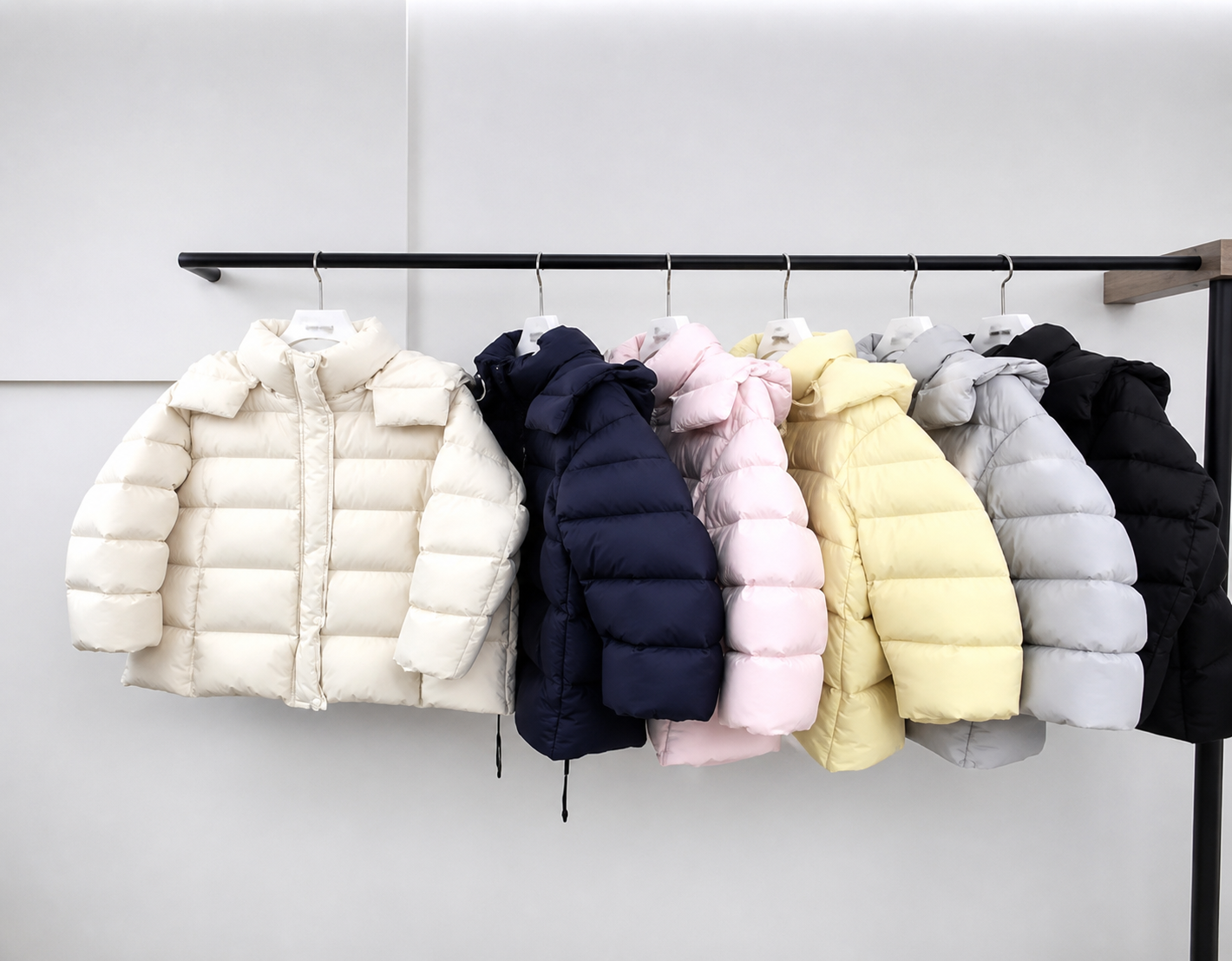
What “goose down outerwear” means in a sourcing brief
Goose down outerwear is a category of insulated garments—jackets, parkas, vests, and full-length coats—where the primary thermal layer is a cluster fill from geese rather than synthetic insulation. The fill is typically a blend of down clusters and small feathers, and its performance depends on the ratio and quality of those clusters. In a B2B sourcing brief, the term should be pinned down before sampling: species, fill power, down-to-feather ratio, shell fabric, construction method, and any certification or traceability requirement.
Buyers often use “goose down” loosely. A supplier may quote “90/10 goose down” (90% down clusters, 10% feathers) or “95% white goose down,” as in the supplied product evidence for a full-length coat. Those numbers describe composition, not warmth by themselves. Warmth also depends on fill weight (grams per garment or per square meter), baffle design, and the shell’s ability to block wind. Treat composition, fill power, and fill weight as three separate specification lines.
Key specification decisions before you request samples
Fill power and fill weight
Fill power measures how much volume a given weight of down occupies under a standardized test—typically cubic inches per ounce (in³/oz) in the US or cubic centimeters per gram (cm³/g) elsewhere. Higher fill power means more loft per gram, which can allow a lighter garment for a given warmth target. It does not automatically mean a warmer garment if fill weight is low.
For a buying decision, specify both:
- Fill power range (e.g., 600–650, 700–750, or 800+) and the test method the supplier will report against.
- Fill weight per size or per panel, with a tolerance. Ask how the supplier controls fill weight on the line—weighing stations, batch records, or sample cutting.
If a supplier quotes only “high fill power” without a number or test method, ask for a current test report and the lab’s scope. Test reports are batch-specific; a report from last season does not automatically apply to your production lot.
Species and color
White goose down is preferred where the shell fabric is light or translucent, because dark feathers can show through. Color is largely a cosmetic and contamination-control issue, not a thermal one. Species claims (goose vs. duck) should be supported by documentation if they matter to your brand story or price positioning.
Shell fabric and down-proofing
Down clusters migrate through loose weave. Down-proof shells use tighter construction, calendering, or a coating to reduce leakage. The trade-off: tighter, coated fabrics can feel stiffer and may reduce breathability. For a full-length coat, the shell also carries the wind and water-resistance story. Specify:
- Fabric composition and weight (e.g., nylon or polyester taffeta, typically in a defined g/m² range).
- Down-proof performance: ask for a leakage or migration test result, or a fabric specification from the mill.
- Any finish (calendered, coated, laminated) and its effect on hand-feel and breathability.
Construction: baffles, stitching, and cold spots
Down needs loft space. Sewn-through construction (stitching directly through the outer and lining) is lighter and cheaper but creates cold spots at each stitch line. Baffle construction (fabric walls between panels) preserves loft and reduces cold spots but adds weight and cost. Box-wall baffles are common in colder-weather parkas; stitch-through is common in lighter fashion jackets.
Ask for a construction cross-section drawing or a physical sample cutaway. Check baffle height consistency and stitch density. On a full-length coat, also check the hem, cuff, and hood for draft protection—elastic cuffs, internal storm cuffs, and adjustable hems affect real-world warmth more than a fill power number alone.
Certification and traceability: what to verify
Responsible Down Standard (RDS) is the most widely referenced certification for down traceability and animal welfare in apparel supply chains. If your brand requires RDS, specify it in the purchase order and ask for the transaction certificate or scope certificate that covers your supplier and the specific down lot. Certification is chain-of-custody based; a supplier’s general claim is not the same as documentation for your order.
Other claims—origin country, species, live-plucking prohibition—should be backed by the down supplier’s declaration or a recognized certification. Do not accept a logo on a website as evidence for a production lot. Verify the certificate number, issuing body, and validity date, and confirm the certificate scope includes the product type and facility.
Testing and inspection: a practical verification sequence
Down outerwear fails in predictable ways: leakage, underfill, cold spots, seam failure, and inaccurate composition. Build a verification sequence into the sampling and production timeline.
| Stage | What to check | Evidence to request |
|---|---|---|
| Down lot | Composition, fill power, species, color, certification | Batch test report; RDS transaction certificate if required |
| Shell fabric | Weight, composition, down-proof performance, finish | Mill specification; leakage test result if available |
| Proto sample | Loft, baffle height, fill distribution, seam integrity | Cutaway or X-ray inspection; fill weight record |
| Production | Fill weight per size, leakage, stitch density, labeling | In-line inspection report; AQL final inspection |
For fill weight, a simple check is to weigh a finished garment against the agreed specification. Variation across sizes should follow a documented grading rule. If the supplier cannot show fill weight records, treat the specification as unverified.
Supplier evaluation: questions that separate trading companies from factories
Goose down outerwear involves both garment construction and down handling. A knitwear factory may have strong sewing capacity but limited down processing or down-proof fabric expertise. Ask directly:
- Do you process or blend down in-house, or buy from a down supplier? Who is the down supplier, and can you provide their certification?
- How do you control fill weight on the line? Show the weighing or dosing method.
- Have you produced baffle-construction outerwear? Can you show a construction sample?
- What is your down leakage test method, and what result do you consider acceptable?
- Which production lines or workshops would handle our order, and what is the current capacity loading?
For context, the supplied company evidence for Zhejiang Suxing Knitting Co., Ltd. describes a 100-mu manufacturing base, 7 workshops, 60 production lines, and monthly capacity up to 400,000 pieces across its knitwear and outerwear programs. Capacity figures are only useful when matched to your order size, style complexity, and season. Ask for a capacity allocation by month, not just an annual total.
Cost drivers and trade-offs buyers should model
Down outerwear pricing is driven by fill power, fill weight, shell fabric, construction method, and certification. A higher fill power can reduce fill weight for the same warmth target, but the down cost per gram rises. Baffle construction adds labor and material. RDS certification adds traceability cost. Model these as separate line items in your cost sheet so you can see which specification changes actually move the price.
Common trade-offs:
- Lighter vs. warmer: high fill power plus moderate fill weight can hit a warmth target at lower garment weight, but the shell may need to be lighter too, which can reduce durability.
- Fashion vs. function: sewn-through, cropped, or slim silhouettes look cleaner but create cold spots and limit layering.
- Certification vs. cost: RDS adds documentation and supply-chain controls; decide whether it is a brand requirement or a nice-to-have before quoting.
Labeling, care, and compliance details that cause chargebacks
Down outerwear labeling is regulated in many markets. In the US, the FTC requires textile fiber content and country of origin labeling; down and feather content claims must be accurate. In the EU, textile labeling and care labeling rules apply. Confirm the labeling standard for your destination market and have the supplier provide a label proof before production.
Care instructions affect consumer satisfaction. Down garments typically require specific washing and drying instructions to preserve loft. Ask the supplier to confirm care content with the down and shell suppliers, and test a wash-and-dry cycle on a sample to check for leakage, clumping, and seam distortion.
How this fits a broader knitwear and outerwear program
Buyers often source goose down outerwear alongside knitwear for a coordinated seasonal collection. The supplied product evidence includes knitwear items such as the Beaded Crewneck Wool Sweater (models JM5361 and JM5362) and the Full-Length Goose Down Coat (model JM53141, with 95% white goose down). A mixed program can simplify logistics and sampling communication, but it also requires the supplier to manage different material streams—wool yarn and down fill—under one quality system. Ask how the supplier separates down handling from knitwear production to avoid contamination, and confirm that sampling timelines for both categories are realistic.
If you are evaluating a supplier for both categories, request references or sample records for each category separately. A strong knitwear program does not automatically prove down outerwear capability, and vice versa.