
Goose Down Outerwear Sourcing: A Buyer's Guide to Specs and Verification
A practical framework for sourcing goose down outerwear: fill power, construction, compliance, and factory verification, with clear trade-offs and questions to ask.
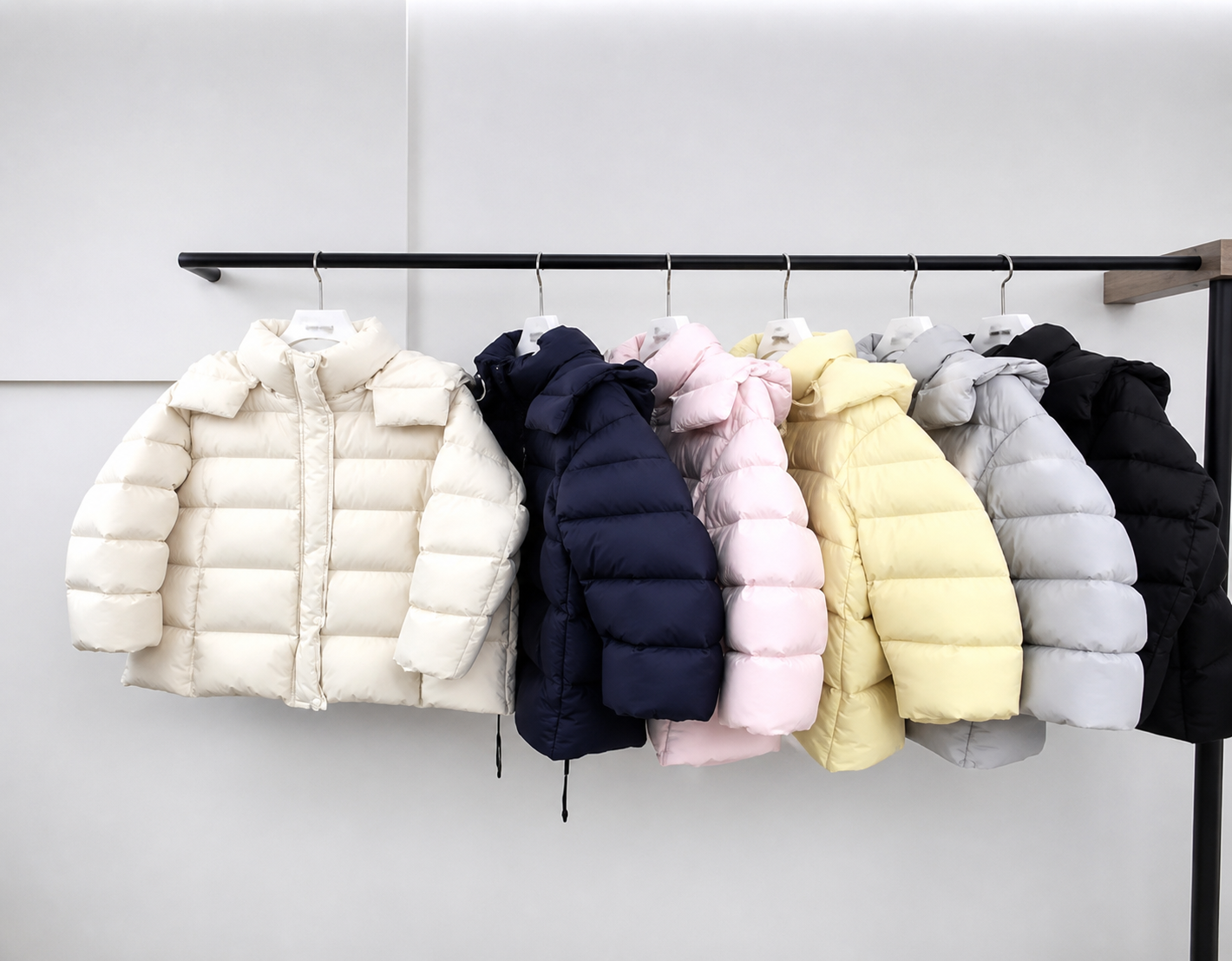
What “goose down outerwear” means in a sourcing brief
In a B2B sourcing context, goose down outerwear refers to insulated garments—jackets, coats, vests, and parkas—where the primary thermal layer is a cluster fill from geese, typically described by down content (the percentage of down clusters versus feathers) and fill power (a measure of loft). The garment is a system: down fill, shell and lining fabrics, baffle or stitch construction, trims, and labels all determine warmth, durability, and compliance. A specification that names only “95% goose down” leaves most of the decisions open.
This guide is for buyers and product developers building a private-label or retail program. It sets out the decisions to lock before sampling, the verification steps that catch common failures, and the limits of what a supplier questionnaire can prove.
Start with the use case, not the down percentage
Down percentage and fill power are inputs, not outcomes. The same 95% white goose down can produce a light urban jacket or a expedition-weight parka depending on fill weight (grams of down per garment or per body zone), baffle design, and shell air permeability. Define the operating conditions first: expected temperature range, activity level, wind and moisture exposure, wear frequency, and packability requirements. Then translate those into a thermal target and a fill weight range.
A useful decision rule: if the garment will be worn in wet snow or steady rain, down’s performance when damp becomes a primary risk. Either specify a water-resistant down treatment or a shell that limits moisture ingress, and test the combination. If the garment is primarily a fashion layer, prioritize drape, silhouette, and stitch detail over extreme fill power.
Questions to settle before requesting samples
- What temperature and activity range must the garment handle, and is that a comfort or survival target?
- Is the silhouette close-fitting (needs stretch or articulated patterning) or oversized (needs baffle control to avoid cold spots)?
- Will the garment be packed for travel, and what compressed volume is acceptable?
- Which market’s labeling and chemical rules apply, and who is responsible for demonstrating conformity?
Specify the down fill in verifiable terms
Down specifications should be written so a third-party lab can test them. At minimum, state down content percentage, fill power and the test method used, species and color (white or grey), and any treatment (for example, water-resistant finish). Fill power is commonly reported under established loft test methods; the number is only comparable when the method and conditioning are the same. Ask the supplier to state the method on the spec sheet rather than quoting a bare number.
Traceability is a separate claim from quality. If your brand requires responsibly sourced down, specify the certification scheme and the chain-of-custody documentation you will accept, and confirm that the certificate covers the specific lot and supplier. A certificate for a trading company is not automatically evidence for the sewing factory’s incoming lot.
Down specification fields to put on the tech pack
| Field | Why it matters | Verification route |
|---|---|---|
| Down content (% clusters vs. feathers) | Affects loft, weight, and insulation consistency | Composition test by an accredited lab |
| Fill power and test method | Loft performance; only comparable under the same method | Lab report stating method and conditioning |
| Species and color | Labeling accuracy and consumer expectations | Microscopy or DNA-based species identification where required |
| Treatment (e.g., water-resistant) | Damp-weather performance and durability | Supplier declaration plus performance test on finished shell assembly |
| Traceability certification | Brand sourcing policy and market access | Certificate scope and transaction certificates for the lot |
Note a limitation: fill power measured on loose down does not predict the warmth of the finished garment. Baffle geometry, overfill or underfill, seam leakage, and shell fabric all change the result. Treat the down spec as one control point, not the whole quality plan.
Shell, lining, and baffle construction decide real-world performance
The outer fabric controls wind resistance, water repellency, breathability, and abrasion life. Specify fabric weight, construction (woven or knit), finish, and minimum performance values for hydrostatic head and air permeability if the garment is positioned for weather exposure. For fashion-led programs, hand feel, sheen, and drape may outrank technical values—but say so explicitly so the factory does not over-engineer the shell and raise cost.
Baffle construction is where many samples fail. Sewn-through baffles are lighter and cheaper but create cold spots along stitch lines. Box-wall or baffle-box construction reduces cold spots but adds weight and complexity. For a full-length coat, check baffle spacing at shoulders, chest, and hem, and confirm that the down cannot migrate to the hem during wear. Ask for a fill-weight map by body zone if the design is zoned.
Construction checks during sample review
- Hold the sample against a light source to spot thin areas and down migration paths.
- Flex the shoulders and elbows; listen and feel for stitch pull or baffle distortion.
- Inspect seam sealing and stitch density at high-stress points.
- Weigh the sample and compare against the target fill weight plus shell weight budget.
- Check zipper, snap, and drawcord hardware for cold-weather function with gloves.
Compliance and labeling: assign responsibility early
Down and feather products face labeling and, in some markets, traceability or chemical restrictions. Rules vary by destination and change over time, so confirm current requirements with your compliance team or a qualified testing provider before finalizing the tech pack. Put responsibility in writing: who supplies the test reports, who holds the certificates, and which party is accountable if a shipment is detained. A factory that can describe its incoming-material inspection and lot segregation is easier to audit than one that only forwards certificates.
Common failure modes include label composition that does not match the fill, species mislabeling, and certification that covers the down supplier but not the finished garment. Build a pre-production verification step and a bulk inspection step that sample from finished garments, not from loose down.
Sampling and production verification sequence
A staged sequence catches problems while changes are still cheap. The exact number of rounds depends on design complexity; the logic is to verify materials before construction, and construction before bulk.
- Material sign-off: approve down lot, shell, lining, and trims against written specs and lab reports.
- Proto sample: check silhouette, baffle layout, and fill-weight distribution.
- Fit and wear trial: test range of motion, cold-spot feel, and packability with the target user group.
- Pre-production sample: confirm construction, labeling, and packing; freeze the spec.
- Bulk inspection: measure fill weight on sampled garments, check seam integrity, and verify labels against the approved standard.
For buyers sourcing across categories, the same discipline applies to knitwear programs. A wool sweater manufacturer and a down outerwear line share material traceability, labeling, and sampling controls, even though the performance risks differ. Consolidating these checks across a supplier base reduces duplicated audits.
Factory capability: what to verify beyond the brochure
Capacity figures and workshop counts describe scale, not fitness for your program. Verify the specific lines that will run your garment: down filling equipment and containment, baffle sewing expertise, and finishing. Ask how the factory controls down leakage and how it cleans equipment between lots to avoid contamination. For blended programs—for example, a supplier that also runs knitwear—confirm that down filling and knitting are physically separated enough to protect both products.
Zhejiang Suxing Knitting Co., Ltd. (suxingapparel.com) describes itself as supporting export-oriented knitwear, wool sweater, goose down outerwear, OEM, and ODM apparel programs, with a 100 mu manufacturing base, 7 workshops, 60 production lines, and monthly production capacity up to 400,000 pieces. These are supplier-stated figures; verify them against your order size, delivery window, and audit findings. As a reference product, the Full-Length Goose Down Coat (model JM53141) is listed with 95% white goose down and OEM/ODM support, with size, color, fabric, workmanship, labeling, and packing confirmed through the B2B inquiry process.
Audit questions that reveal real control
- Which specific line will produce our garment, and what else runs on it this season?
- How do you verify incoming down lots, and can we see the last three lot records?
- What is your down-leakage defect rate, and how is it measured?
- Who signs the labeling declaration, and what evidence supports it?
- What happens when a bulk fill-weight check falls outside tolerance?
Trade-offs to decide deliberately
Every down program balances warmth, weight, packability, weather resistance, and cost. Higher fill power usually allows a lighter garment for the same loft, but it costs more and may be unnecessary for fashion-led pieces. Water-resistant treatments add cost and can affect hand feel. Denser shells improve wind resistance but reduce breathability. Sewn-through baffles save weight and cost but create cold spots. Write these trade-offs into the brief so sampling evaluates the intended compromise rather than an accidental one.
A practical rule for buyers: fix the two or three performance attributes that define the product, and allow flexibility on the rest. A coat defined by warmth and weather protection should not be sampled against a packability target that forces underfill.