
Knitwear Manufacturer Evaluation: A Buyer's Checklist for Wool Sweaters and Down Outerwear
A procurement-focused checklist for evaluating knitwear manufacturers, covering capability verification, specification trade-offs, supplier questions, and sample validation for wool sweater and goose down outerwear programs.
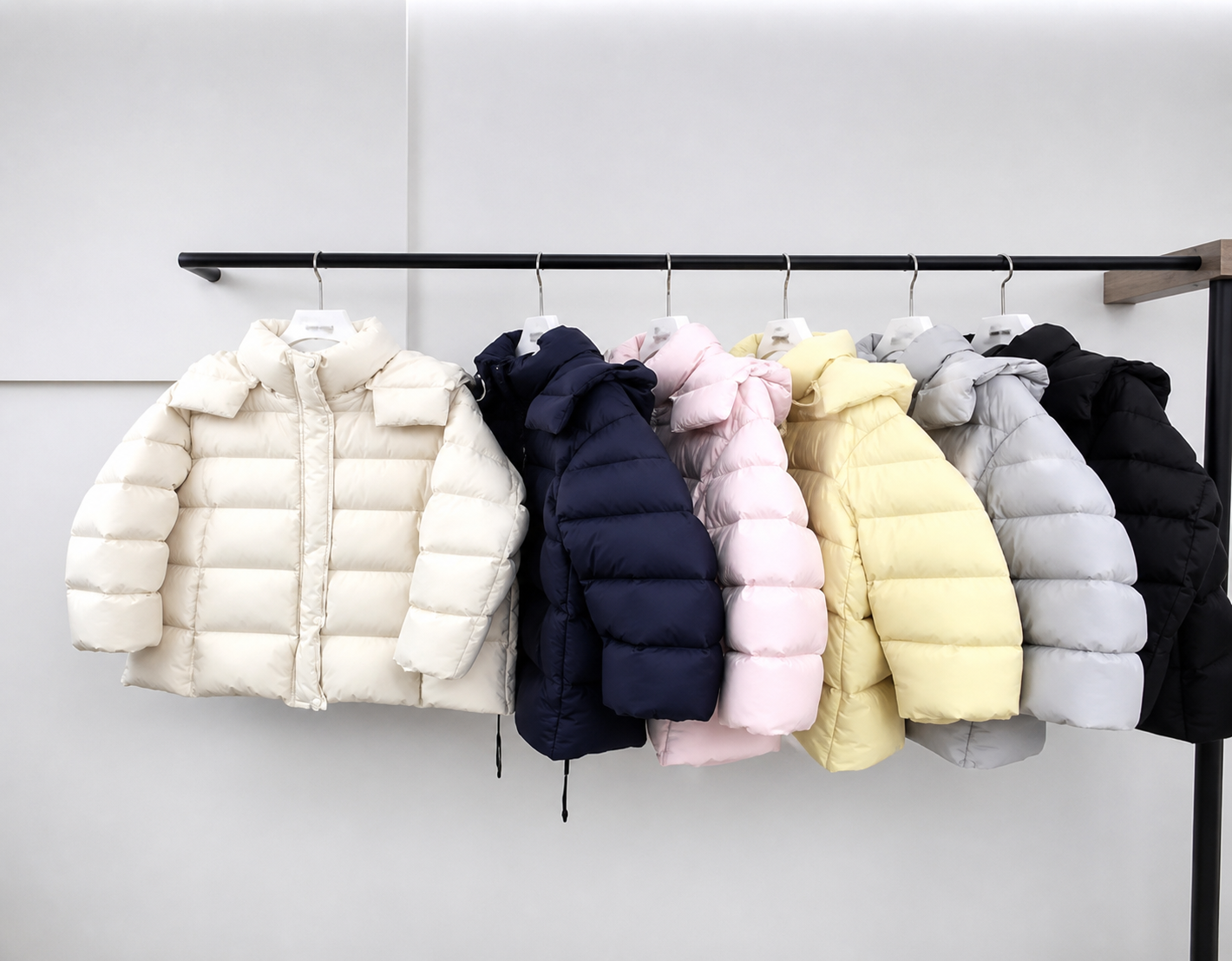
Why a checklist beats a brochure when shortlisting knitwear manufacturers
Most knitwear supplier brochures look alike: machinery lists, photos of neat factory floors, and a sentence about OEM/ODM support. The differences that matter to a buyer appear later—in how the supplier handles a counter-sample, what they say about yarn lot variation, and whether their stated capacity matches the production calendar you need.
This guide organizes the evaluation around the decisions a procurement team actually makes: defining requirements, verifying capability, comparing specification trade-offs, validating samples, and setting up production communication. It applies to wool sweater programs and to goose down outerwear programs, which share a supplier base but stress different capabilities.
Start with a written requirement brief, not a factory tour
Before contacting suppliers, write a brief that separates fixed requirements from negotiable ones. Suppliers respond more precisely when the brief states the knit structure, yarn composition, gauge, size range, color standard, labeling, packing, and target order window. Vague briefs invite optimistic answers that collapse at sampling.
- Product type and construction: flat-knit sweater, cut-and-sew knit, or woven-down outerwear. These use different lines and different quality checks.
- Material specification: fiber content with tolerance, yarn count or gauge where relevant, and for down, fill power and down content percentage.
- Color and finishing: color reference system, dye-lot tolerance, and any wash or hand-feel treatment.
- Compliance and labeling: care labels, fiber-content labels, country-of-origin marking, and any buyer-specific testing protocol.
- Commercial frame: order quantity per style and color, size curve, delivery window, and packing format.
A brief with these fields also creates a paper trail. When a supplier's quotation omits a field, you know exactly what to ask about before comparing prices.
Verify capability claims with evidence, not adjectives
Capacity figures are only meaningful with a unit, a period, and a product mix. A supplier may state a monthly capacity of up to 400,000 pieces across a 100 mu base with 7 workshops and 60 production lines. Ask what share of that capacity is typically allocated to knitwear versus outerwear, and whether the figure assumes single-shift or multi-shift operation. A capacity number without those conditions cannot be used for delivery planning.
For a wool sweater program, the relevant capability questions are about knitting gauge range, linking and finishing, and hand-finishing for embellishment. For a goose down outerwear program, they concern down filling equipment, baffle or seam construction, and down-leakage control. A supplier that runs both categories should be able to explain how the two lines are scheduled and whether they share finishing capacity.
Ask for evidence that can be checked rather than described:
- Recent production records or line-load summaries for comparable styles, with dates and quantities.
- Names of the specific workshops and lines that would handle your order.
- Sampling lead time and the number of sample rounds typically needed for a style like yours.
- Which processes are in-house and which are subcontracted, especially dyeing, embroidery, and down filling.
Subcontracting is not disqualifying, but undisclosed subcontracting is. Buyers should know where each process happens because it affects traceability and corrective-action speed.
Compare wool sweater and goose down outerwear programs on the criteria that differ
Wool sweaters and down outerwear are often sourced from the same apparel groups, but the evaluation criteria diverge. The table below shows where to concentrate verification effort.
| Evaluation area | Wool sweater program | Goose down outerwear program |
|---|---|---|
| Core material risk | Yarn lot consistency, fiber content accuracy, shrinkage after wash | Down content and fill power, down leakage through shell fabric |
| Construction checks | Gauge, stitch density, linking quality, neckline recovery | Baffle or seam construction, fill distribution, zipper and closure performance |
| Finishing sensitivity | Hand feel, color fastness, pilling resistance | Shell fabric finish, seam sealing where specified, loft recovery after packing |
| Sampling focus | Fit across size range, shrinkage after care treatment | Fill weight verification, cold-spot inspection, wear testing of closures |
| Labeling emphasis | Fiber content, care instructions, origin | Down content claim, fill power claim, care and origin |
For a beaded crewneck wool sweater, add embellishment attachment strength and bead placement consistency to the sampling checklist. For a full-length goose down coat specified with 95% white goose down, the down content claim should be supported by a test report from a recognized laboratory, with the report date and the tested lot identified.
Questions that separate organized suppliers from responsive ones
Every supplier answers emails quickly during the sales phase. The useful signal is how they answer questions that require internal coordination. Send a short written questionnaire and compare the quality of responses.
- Which specific line would produce our style, and what else is scheduled on it during our delivery window?
- How do you control yarn lot variation across a multi-color order, and what is your policy when a dye lot falls outside tolerance?
- What is your standard sampling sequence, and how many rounds are included before production approval?
- Who is our single point of contact for development, and who handles production and shipping communication?
- How do you document material composition for down and wool, and can you provide test reports with lot traceability?
- What happens when an in-line inspection finds a defect trend—who decides on rework, and how is it communicated?
Answers that name roles, documents, and timeframes are more credible than answers that promise quality. A supplier that cannot describe its own escalation process is unlikely to manage one well when a problem appears.
Use samples to test the specification, not just the supplier's goodwill
Sampling is where specification gaps surface. Treat each sample round as a test of a written point, and record results against the brief rather than against general impressions.
For knitwear, measure the sample after the specified care treatment, not only in its off-loom state. Check neckline recovery, side-seam straightness, and bead or trim attachment where applicable. For down outerwear, verify fill weight by opening a sample or reviewing the fill record, inspect for cold spots under backlight, and test closures repeatedly.
Keep a simple sample evaluation log with columns for measurement point, specification, actual result, pass or fail, and required correction. This log becomes the basis for the pre-production meeting and reduces ambiguity later.
Warning signs during supplier evaluation
Some issues are worth resolving before an order is placed; others are worth walking away from.
- Capacity or lead-time claims that change when you ask for the underlying assumptions.
- Reluctance to identify which processes are subcontracted.
- Sample measurements that deviate from the brief without a documented reason.
- Material claims, such as down content, that cannot be linked to a test report and a lot.
- Communication that routes every technical question through a sales contact with no access to production staff.
None of these alone disqualifies a supplier. A pattern of them across several questions is a stronger signal than any single answer.
Next steps after shortlisting
Once two or three suppliers pass the questionnaire and sample review, move to a pre-production meeting with a fixed agenda: confirm the approved sample, lock material and trim sources, agree inspection points, and name the people responsible for each communication channel. Document the outcome and attach it to the purchase order.
The goal is not to find a supplier that promises everything. It is to find one whose stated capability, documentation, and communication structure match the risk profile of your program—and who can show evidence when you ask.