
SUXING International: A Technical Buyer's Guide to Knitwear and Down Outerwear Manufacturing
A technical evaluation of SUXING International's knitwear and goose down outerwear manufacturing, covering material choices, production capacity, OEM/ODM support, and verification steps for B2B buyers.
What SUXING International Supplies to Export Apparel Programs
SUXING International (Zhejiang Suxing Knitting Co., Ltd.) is a China-based manufacturer serving export-oriented knitwear and outerwear programs. Its product scope includes wool sweaters, knitwear, and goose down outerwear, with OEM and ODM development support. The company operates a 100-mu manufacturing base with seven workshops and 60 production lines, and reports monthly production capacity of up to 400,000 pieces.
For technical buyers, the relevant question is not whether the company can make a sweater or a down coat—many factories can. The question is whether its material choices, process controls, and communication workflow match the tolerances and timelines of your program. This guide breaks down the decision points that matter when evaluating SUXING International or any comparable manufacturer.
Material and Construction Choices That Drive Performance
Wool sweaters: fiber, gauge, and finishing
Wool sweater performance depends on fiber diameter, yarn twist, knit gauge, and finishing. Finer fibers reduce prickle, but they also increase cost and can lower abrasion resistance. Gauge—needles per inch—determines fabric density and drape; higher gauge gives a finer hand but slower production. Buyers should specify fiber content, yarn count, gauge, and hand-feel targets in the tech pack, then confirm them against a physical sample.
SUXING International's product evidence includes beaded crewneck wool sweaters (models JM5361 and JM5362) in the pure wool sweaters category. The beadwork adds a hand-finished step that can affect lead time and inspection criteria—bead attachment strength and placement accuracy should be added to the QC checklist.
Goose down outerwear: fill power, shell, and baffle design
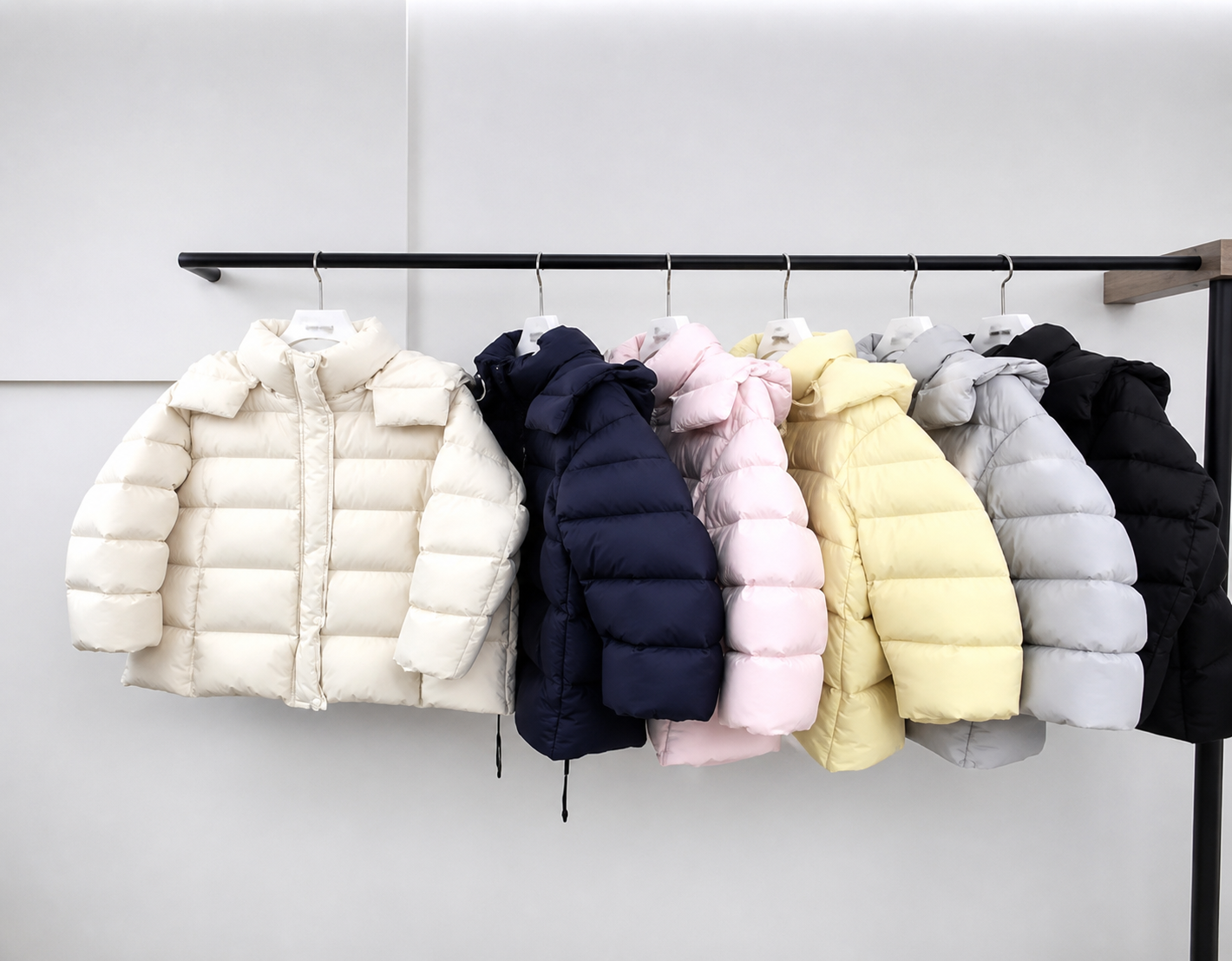
For down outerwear, the key specification is fill power (cubic inches per 30 grams), which determines warmth-to-weight ratio. The supplied product evidence for the full-length goose down coat (model JM53141) lists 95% white goose down as a key material. Down percentage (95% down, 5% feather) affects loft and insulation consistency. Shell fabric denier, coating type, and baffle construction control down leakage and wind resistance. Buyers should request fill power test reports and shell fabric specs before approving a bulk order.
Production Capacity and What It Means for Scheduling
A reported capacity of 400,000 pieces per month across 60 production lines suggests the factory can handle large seasonal programs. But capacity figures are only useful when matched to your order profile. A 400,000-piece monthly ceiling may be split across many buyers and product types; your actual allocation depends on line scheduling, material lead times, and seasonal peaks.
Ask for a line-loading plan that shows how your order fits into the production calendar. For down outerwear, factor in down filling and baffle sewing, which are slower than flat knitwear production. For beaded sweaters, handwork stations may become a bottleneck. The practical test is a capacity audit tied to your specific styles, not a headline number.
OEM vs. ODM: Which Development Path Fits Your Program
SUXING International offers both OEM and ODM support. In OEM, you supply the design and tech pack; the factory executes to your specifications. In ODM, the factory proposes designs or adapts existing styles, which can shorten development time but may reduce differentiation if the same styles are offered to other buyers.
For technical buyers, the choice affects IP control, sampling cost, and timeline. OEM requires a complete tech pack with graded specs, construction details, and labeling instructions. ODM requires a clear agreement on exclusivity and design ownership. Clarify which model applies before sampling begins.
Verification Steps Before Committing to a Program
- Material verification: Request test reports for wool fiber content and down fill power from a recognized laboratory. Confirm the report date and the specific lot tested.
- Sample approval: Evaluate a production-representative sample, not a prototype. Check measurements against your size chart, seam strength, and bead attachment (for beaded styles).
- Factory audit: If your compliance team requires it, schedule an on-site or third-party audit covering working conditions, chemical management, and quality systems.
- Pre-production meeting: Confirm labeling, packing, and inspection standards in writing before bulk production starts.
Common Failure Modes and How to Catch Them Early
In wool sweaters, shrinkage and pilling are frequent complaints. Specify shrinkage limits after washing and request a pilling test (e.g., Martindale or PillGrade) on the finished fabric. In down outerwear, down leakage through seams and cold spots from uneven fill are common. Inspect baffle stitching and request fill-weight checks per panel. For beaded styles, loose beads create safety and returns risk; a tug test on a sample can reveal attachment quality.
Decision Framework: Is SUXING International the Right Fit?
| Factor | What to Confirm | Why It Matters |
|---|---|---|
| Product scope | Wool sweaters, knitwear, goose down outerwear | Matches programs needing both knit and down categories |
| Capacity | 400,000 pieces/month reported; line allocation for your order | Large volume potential, but confirm scheduling |
| Development model | OEM and ODM support | Flexibility for private label or design-led programs |
| Material specs | 95% white goose down (JM53141); pure wool (JM5361/JM5362) | Baseline for performance and cost |
| Customization | Size, color, fabric, labeling, packing | Supports private-label requirements |
Use this table as a starting checklist. The next step is to request a sample and a capacity plan for your specific styles.